Field Notes — April 16
Lessons in Humidity, Soil, and Scale
It’s April 16th, and we’re fully in it now—the pace of spring has taken over, and the field is driving the decisions.
The black garlic experiment—Proctor Silex roaster and all—wasn’t a total failure, but it was close enough to call it a lesson. The biggest issue wasn’t temperature. It was humidity. We could get moments of that jammy, rich texture, but we couldn’t hold it consistently across the bulbs. Some sections softened beautifully, others stayed dense and dry. We kept pushing, trying to even it out, but that’s not what you get from an oven roaster.
So that’s filed away as something to return to later, with better control and a better understanding of what’s actually required. Black garlic isn’t just about heat. It’s about holding the right environment over time.
But spring doesn’t wait for experiments to resolve.
Now we’re in the field, and the focus has shifted to fertility—specifically nitrogen. The garlic is actively growing, and more importantly, the soil is active. You can feel it in how quickly inputs move through the system. This isn’t a dormant period where things sit and wait. The microbiome is awake, and it’s ready to work.
What’s happening below the surface is less visible, but it’s driving everything.
The garlic roots release sugars into the soil, feeding microbes—bacteria and fungi that break down organic matter and convert nutrients like nitrogen into forms the plant can actually use. In return, the plant takes those nutrients up through its roots. It’s not a one-way system. It’s a loop. We’re not just feeding the garlic—we’re feeding the system that feeds the garlic.
That’s why timing matters so much right now. When soil temperatures rise and moisture is present, microbial activity increases. What we apply doesn’t just sit there. It moves, transforms, becomes available. The response is immediate in a way it isn’t at other times of year.
We’ve learned a lot about this the hard way.
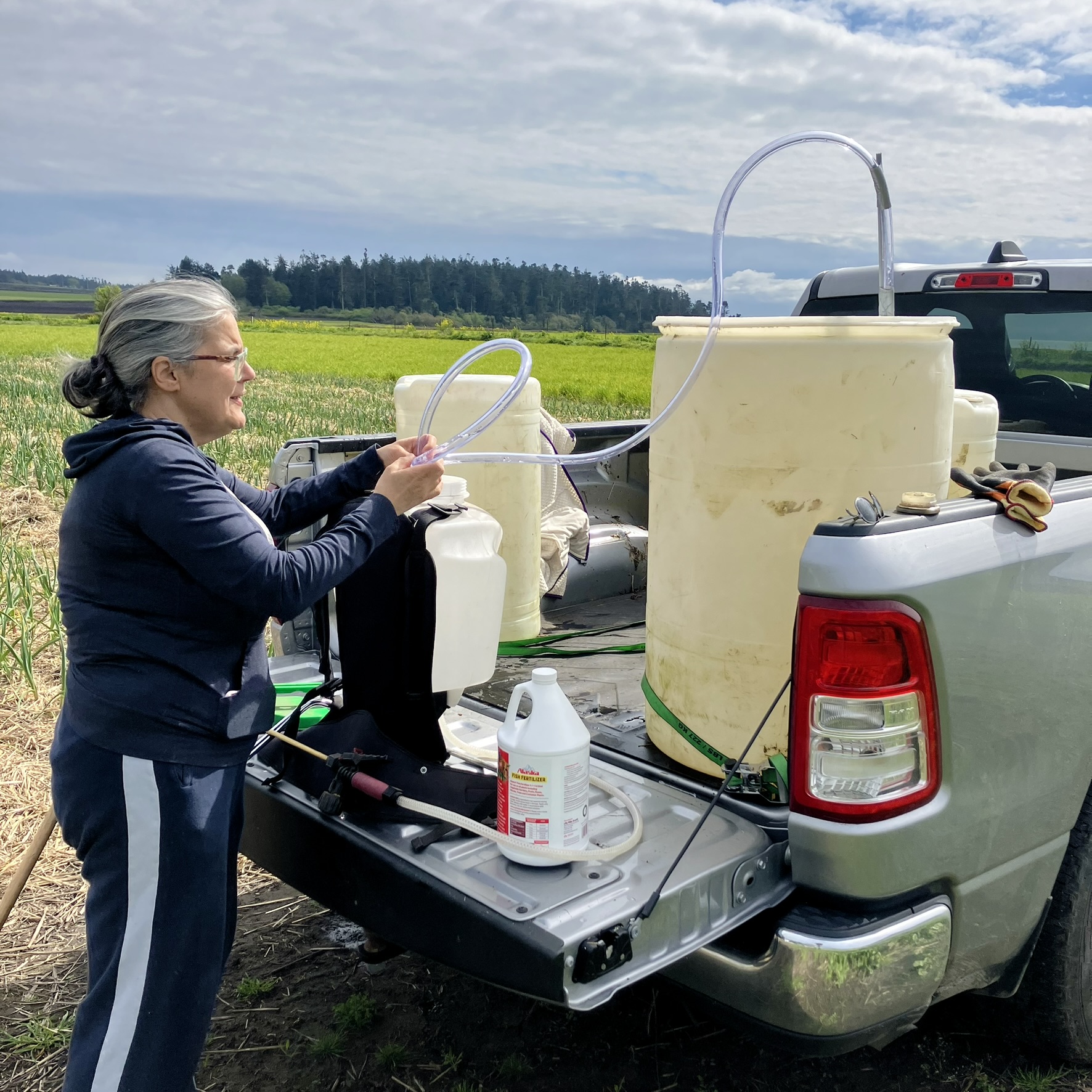
We started out carrying a four-gallon sprayer, working bed by bed. It works—but it’s not sustainable. Not at this scale, and definitely not with what’s coming next. My husband still swears by it for now, and I understand why. It’s simple and direct, but also exhausting. And as the planting size increases, that approach stops making sense.
We’re already looking ahead to a Venturi injector setup tied into our irrigation system, which allows us to move inputs efficiently and evenly without breaking ourselves in the process.
Because the shift is happening.
We went from just under 200 pounds planted to knowing that next season we’ll be planting 600–700 pounds. That changes everything. Not just how much we do, but how we do it.
Right now, the garlic is growing. The soil is active. The system is responding.
And we’re starting to understand, in a more grounded way, what it actually takes to build something that can scale.
We’re still learning. Still adjusting. Still doing some things the hard way before we figure out what holds.
But the patterns are starting to show.
And that’s enough to keep moving forward.